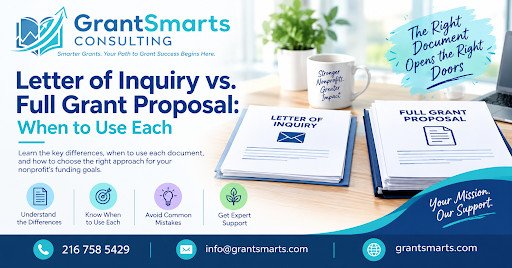
When to Use Letter of Inquiry vs full grant proposal? Use a letter of inquiry when a funder asks for a brief introduction before accepting applications, and use a full grant proposal when the funder invites you to apply or publishes guidelines that call for a complete application. A letter of inquiry is a short summary, usually one to two pages, that asks whether the funder is interested in your project. A full grant proposal is the complete document, with the need, plan, evaluation, budget, and attachments. The funder’s written instructions should always guide your choice. GrantSmarts Consulting is a team of grant consultants in Middleburg Heights, OH that offers grant writing services and grant writing assistance to nonprofits in Middleburg Heights and surrounding areas, including help with both letters of inquiry and full proposals.
Many nonprofit leaders lose time on grants for a simple reason: they send the right document at the wrong moment. A beautifully written proposal does little good if the funder only asked for a short letter. Likewise, a brief letter will not help if the funder wanted a complete application. Therefore, understanding the difference between a letter of inquiry and a full grant proposal is one of the most practical skills in fundraising.
This guide explains what each document is, how to tell which one a funder wants, and how to prepare so that you are ready for either.
What Is a Letter of Inquiry?
A letter of inquiry, often shortened to LOI, is a concise document that introduces your organization and your project to a funder. In other words, it is a first impression on paper. Its job is to help the funder decide quickly whether your request fits their priorities.
Funders use letters of inquiry because they often receive many more requests than they can review in full. Consequently, a short first step helps them focus on the projects that match their mission, and it saves applicants from writing long proposals that have little chance of fitting.
You may also see similar terms, such as “letter of intent,” “concept paper,” or “pre-proposal.” These labels are not always used in the same way, so read the funder’s own description before you begin.
What Is a Full Grant Proposal?
A full grant proposal is the complete case for funding. While a letter of inquiry says, “Here is our idea,” a full proposal says, “Here is exactly how we will do it, what it will cost, and how we will measure success.”
Although funders set their own formats, a full proposal commonly includes:
- An executive summary
- Your organization’s background and capacity
- A statement of need supported by evidence
- Goals, objectives, activities, and a timeline
- An evaluation plan
- A detailed budget and budget narrative
- A sustainability plan
- Attachments, such as financial statements, proof of tax-exempt status, a board list, and letters of support
Because it contains so much, a full proposal takes far longer to prepare than a letter, and it often needs input from program staff, finance staff, and leadership.
Letter of Inquiry vs Full Grant Proposal at a Glance
To make the comparison easier, here is a side-by-side summary written in plain terms.
- Main purpose: The LOI tests the funder’s interest. The proposal asks for the funding decision.
- Typical length: The LOI is often one to two pages. The proposal can run many pages, depending on the funder.
- Detail level: The LOI highlights the essentials. The proposal supplies evidence, plans, and numbers.
- Budget: The LOI usually states the total cost and your request. The proposal includes line items and explanations.
- Attachments: The LOI rarely needs many. The proposal often requires several.
- Timing: The LOI usually comes first. The proposal comes after an invitation or by a published deadline.
- Preparation time: The LOI can often be prepared in days. The proposal commonly takes weeks.
Remember that these are general patterns. Some funders define their documents differently, so always follow their instructions.
When to Use a Letter of Inquiry
A letter of inquiry makes the most sense in these situations:
- The funder requires one. Many private and family foundations accept a letter before any full application.
- The funder uses a two-step process. In this case, the letter is step one and the proposal is step two.
- You are approaching a new funder. A short letter is a respectful way to introduce your work.
- You are unsure about fit. A letter lets you test the waters before you invest heavily.
- The guidelines invite questions first. Some funders prefer an early, brief conversation.
In these cases, sending a full proposal instead of a letter can seem like you overlooked the instructions. For that reason, send only what is requested.
When to Use a Full Grant Proposal
On the other hand, a full proposal is the right choice when:
- The funder invited you after your letter of inquiry.
- The guidelines request a complete application directly, with no letter stage.
- There is a published deadline and application portal. Many government and corporate programs work this way.
- The funder provides a standard application form that must be completed in full.
- A program officer has asked you to apply after an earlier conversation.
Even then, read every instruction carefully. Page limits, file types, and required attachments can vary widely, and small mistakes may affect how your application is reviewed.
How to Read Funder Guidelines for Clues
Sometimes the answer is hidden in the wording. Here are phrases to look for and what they often suggest.
- “Submit a letter of inquiry” or “LOI due” points to a letter first.
- “Invitation only” or “we do not accept unsolicited proposals” suggests you need a relationship or an invitation before sending anything long.
- “Apply online” or “application deadline” usually signals a full application.
- “Request for proposals” (RFP) typically means a full proposal that responds to specific requirements.
- “Concept paper” or “pre-application” points to a short first-stage document.
If the wording is unclear, contact the funder. A polite email or call to the program officer is normal in the grant world, and a short clarification can save weeks of work.
What Makes a Strong Letter of Inquiry
Because a letter is short, every sentence has to matter. A strong one generally does the following:
- Opens with the request, so the reader knows immediately what you are seeking
- Explains the need clearly, using one or two credible facts
- Describes the project simply, including who benefits and what will change
- Shows credibility, through your track record, partners, or experience
- States the budget, including the total cost and the amount you are requesting
- Connects to the funder’s priorities, so the reader sees why you chose them
- Closes politely, with an offer to share more and clear contact details
In addition, use plain language, avoid jargon, and keep a professional but warm tone.
How Grant Consultants Can Help
Preparing either document takes research, writing, and organization. For small nonprofits that are already busy with programs and clients, this can be a lot to manage. Working with grant consultants in Middleburg Heights can help in several ways:
- Funder research: identifying foundations and programs that match your mission
- Guideline review: clarifying whether a funder wants a letter, a proposal, or both
- Writing support: drafting clear, persuasive letters and proposals
- Budget support: building budgets that match your project plan
- Project management: tracking deadlines, documents, and follow-up
Grant writing assistance does not replace your knowledge of your community. Instead, it helps you present that knowledge in a way funders can follow. It is also worth saying plainly that no consultant can promise an award, because funders make the final decisions.
Why Choose GrantSmarts Consulting
GrantSmarts Consulting is a grant strategy and grant writing firm serving nonprofits in Middleburg Heights, OH and surrounding areas. As local grant consultants, we provide grant writing services and grant writing assistance in Middleburg Heights, from reviewing a funder’s guidelines to preparing letters of inquiry and complete grant proposals.
Our process is simple. First, we learn about your mission, programs, and funding goals. Next, we review the funder’s requirements with you and recommend the right document and timeline. Then we draft clear, organized materials and help you stay on schedule. We never guarantee awards, but we do offer careful guidance and honest communication throughout.
If you need grant consultants in Middleburg Heights, OH or the surrounding area, we would be glad to talk. Contact GrantSmarts Consulting today to discuss your next funding opportunity.
Frequently Asked Questions
1. What is the difference between a letter of inquiry and a full grant proposal?
A letter of inquiry is a short introduction that tests a funder’s interest, while a full grant proposal is the complete, detailed application.
2. When should I use a letter of inquiry?
Use one when the funder requests it first, follows a two-step process, or welcomes introductions from new organizations.
3. When should I submit a full grant proposal?
Submit one when the funder invites you after your letter, or when its guidelines call for a complete application directly.
4. Can I send a full proposal instead of a letter of inquiry?
Only if the funder’s guidelines allow it. If a letter is required, follow that process.
5. Where can I find grant writing services in Middleburg Heights, OH?
GrantSmarts Consulting provides grant consulting, grant writing services, and grant writing assistance to nonprofits in Middleburg Heights, OH and surrounding areas.
Contact Us for Your Grant Consultants Service in USA
Company Name: GrantSmarts Consulting
Address: 7055 Engle Rd, Building 6-601, Middleburg Heights, OH 44130
Phone: +1 2167585429
Visit Our Website: Click Here
Google Business Profile