Finding grants for your nonprofit is one of the first questions every nonprofit leader asks — and one of the hardest to answer well. The problem isn’t that there aren’t enough grants. There are over 100,000 active grantmaking foundations in the United States alone, plus thousands of federal, state, and corporate programs. The problem is knowing where to look, how to filter for fit, and how to move from a list of funders to a funded proposal.
In this blog article, we’ll cover both the proven fundamentals and the newest tools and strategies nonprofit leaders are using in 2026 to find better-fit funders, faster — including AI-powered prospecting tools that are changing the game for development teams of all sizes.
Start Here: The Four Categories Grants for Your Nonprofit Should Know Every Nonprofit
Before you search, it helps to understand the four main sources of nonprofit grants. Each has a different application process, timeline, and level of competition.
1. Foundation Grants
Private, family, and community foundations are the most common grant source for nonprofits. They range from large national funders like the W.K. Kellogg Foundation to local community foundations serving a single county. Most accept applications either on a rolling basis or during defined grant cycles (typically 1–2 times per year).
Important: 90% of foundations don’t have websites. This means you cannot find them through Google alone — you need a grants database to access the full landscape.
2. Federal Government Grants
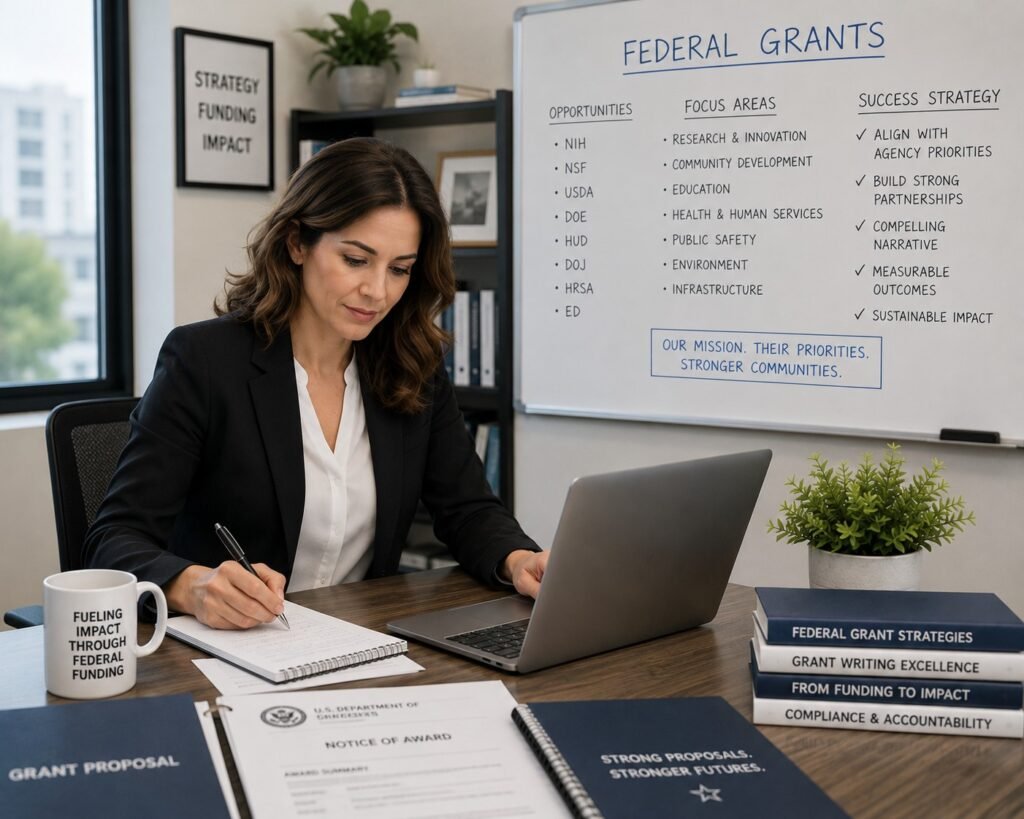
The federal government distributes billions in grant funding annually through agencies like HHS, HUD, the Department of Education, and AmeriCorps. Federal grants are large (often $200K–$2M+), but come with significant compliance requirements. Most are announced on Grants.gov. For nonprofits under $1M, federal pass-through grants distributed by state agencies are often a more accessible entry point.
3. State & Local Government Grants
State agencies, county governments, and municipalities distribute both their own funds and federal pass-through dollars to local nonprofits. These grants tend to be smaller than direct federal awards but have less competition and simpler applications. Your state’s health and human services department, housing authority, and education agency are the best starting points.
4. Corporate Grants
Companies give through corporate foundations, CSR programs, and employee giving initiatives. Corporate grants are often relationship-driven, geographically focused (near company offices or operations), and tied to specific cause areas that align with the company’s brand. They tend to move faster than foundation grants and often have rolling deadlines.
The Traditional Toolkit: Where to Search for Grants
Candid Foundation Directory — The Industry Standard
Candid’s Foundation Directory is the most comprehensive foundation database in the country, with profiles on over 300,000 grantmakers and detailed historical grants data. Its most powerful feature isn’t the funder profiles — it’s the grants history, which shows you exactly which organizations a foundation has funded over time. That tells you far more than their stated mission ever will.
Cost: Paid subscriptions for full online access. Free in-person access is available at over 400 partner locations, including most public libraries. Nonprofits that earn a Candid Gold Seal of Transparency can access Candid Premium for free — a significant deal worth pursuing.
Grants.gov — The Federal Gateway
Every federal grant opportunity is posted on Grants.gov. You can search by agency, eligibility type, funding category, and deadline. Set up email alerts for your keyword terms so new opportunities land in your inbox automatically. This is the non-negotiable starting point for any nonprofit exploring federal funding.
Your State’s Nonprofit Association
Most states have a nonprofit association or alliance (e.g., the Indiana Nonprofit Resource Network, the Texas Association of Nonprofits) that maintains a curated list of local and state grant opportunities. These are often less competitive than national databases because fewer nonprofits know to look there. Find yours through the National Council of Nonprofits directory at councilofnonprofits.org.
Your Local Community Foundation
Every metro area and most rural regions have a community foundation that funds local nonprofits. Community foundations are often the most accessible grants for small and emerging organizations — applications are shorter, program officers are reachable, and grant amounts ($5K–$25K) are realistic for early-stage orgs. Find yours by searching “[your city or county] community foundation.”
Innovative Ways to Find Grants in 2026
The grant prospecting landscape has changed significantly in the past two years. AI-powered tools and smarter database platforms are enabling even small nonprofits to do the kind of strategic funder research that used to require a dedicated development team. Here’s what’s new and working.
1. AI-Powered Grant Matching Platforms
The biggest shift in grant prospecting in 2026 is the move from keyword search engines to intelligent matching. Platforms like Instrumentl now use AI to explain why a funder matches your organization — not just that they do. Instrumentl’s Prospecting Assistant can flag gaps between a funder’s stated guidelines and their actual giving patterns, a nuance that used to require hours of manual 990 analysis.
Meanwhile, Candid is merging its GuideStar and Foundation Directory data with machine learning to surface strategic recommendations based on your organization’s profile, past awards, and program areas. The focus is shifting from search engines to strategic intelligence.
Instrumentl lists over 900,000 active funders and sends weekly or daily email alerts of new matching grants — saving development staff from manually checking multiple databases. Plans start at $179/month.
2. Mining IRS 990 Data
Every private foundation files a Form 990-PF with the IRS, which is public record. These filings list every grant a foundation made that year — recipient organization, amount, and purpose. This is the most underused prospecting tool available, and it’s free.
Here’s the technique: identify a nonprofit similar to yours that’s well-funded. Look up their 990 on ProPublica Nonprofit Explorer (free) or Candid to see who’s funding them. Then look up those funders’ 990-PFs to see the full list of other organizations they’ve supported. You’ll surface funders you’d never find through a keyword search.
3. The Google Ad Grant — A Grant That Finds Donors for You
The Google Ad Grant isn’t a cash grant — it’s $10,000 per month in free Google search advertising for eligible nonprofits. While not a traditional grant, it’s one of the most powerful tools available for getting your organization in front of potential donors, volunteers, and partners who are actively searching for what you do.
To access it, sign up for Google for Nonprofits at nonprofits.google.com and verify your status through TechSoup. The grant requires a maintained website and ongoing ad management, but nonprofits that use it strategically report significant increases in organic donor acquisition.
4. Collaborative & Joint Grant Applications
A growing number of funders in 2026 explicitly prefer — or require — applications from coalitions or partnerships rather than single organizations. This is particularly true in housing, education, and public health, where systems-level change requires multiple organizations working together.
If you’ve struggled to meet a funder’s minimum budget or geographic scale requirements, consider partnering with complementary nonprofits for a joint proposal. Beyond access, collaborative grants often come with larger award amounts and longer funding cycles than single-org grants.
5. Donor-Advised Funds (DAFs) — The Overlooked Billions
Donor-Advised Funds are the fastest-growing vehicle in American philanthropy, now holding over $250 billion in assets. Individuals contribute to DAFs for a tax deduction, then recommend grants to nonprofits over time. Historically, DAFs were invisible to nonprofits — but that’s changing.
Instrumentl now includes DAF prospecting in its platform, surfacing DAFs that have funded organizations similar to yours. Fidelity Charitable, Schwab Charitable, and Vanguard Charitable — the three largest DAF sponsors — all allow nonprofits to be searchable and grantable through their platforms. Make sure your organization is registered and updated on all three.
6. LinkedIn Prospecting
Program officers and foundation staff are active on LinkedIn, and many share insight into their funding priorities, what they’re seeing in proposals, and what organizations they’re visiting. Following foundation staff — not just the institution’s page — gives you a window into what a funder values right now, not just what their website says.
More directly: LinkedIn searches for “program officer” + your cause area + your city will surface professionals at foundations and corporate giving programs you may never have heard of. A thoughtful connection request mentioning genuine alignment (not a sales pitch) opens doors that cold applications never do.
7. Conference & Sector Convenings
Funders go to the same conferences as the nonprofits they fund. In the youth space, that might be the Alliance for Strong Families and Communities conference. In housing, the National Alliance to End Homelessness annual conference. In education, the Learning Forward Annual Conference.
These events are prospecting opportunities as much as they are learning opportunities. Funders attend specifically to see what’s working in the field — and many relationships that lead to grants start with a conversation at a breakout session, not an application portal.
How to Evaluate Whether a Grant Is Worth Pursuing
Finding grants is only half the equation. Deciding which ones to apply for is where strategy matters most. Before committing 40+ hours to an application, evaluate each opportunity against these five criteria:
- Mission fit. Does the funder’s stated priority genuinely describe your work — or would you be stretching to fit their language? Funders can tell the difference.
- Budget fit. Is the grant amount meaningful relative to your budget? A $2,500 grant that takes 20 hours to write may not be worth it. Target grants that represent at least 3–5% of your annual budget.
- Geographic fit. Does the funder support your location? Many foundations are place-based and will not fund outside their target region regardless of how strong your proposal is.
- Organizational eligibility. Do you meet their requirements? Check budget minimums and maximums, years in operation, required certifications (like CHDO status for housing grants), and 501(c)(3) status requirements.
- Capacity to deliver. If you win, can you actually implement the program and meet the reporting requirements? Accepting a grant you can’t deliver on damages your funder relationship and reputation.
Building a Repeatable Prospecting System
The most effective grant prospectors don’t search randomly — they build a system. Here’s a simple repeatable workflow:
- Monthly: Run one prospecting session per month using your primary database. Add 3–5 new qualified prospects to your grant calendar.
- Weekly: Review automated alerts from Grants.gov, Instrumentl, or GrantWatch. Flag any high-fit opportunities that need immediate attention.
- Quarterly: Audit your prospect list. Remove funders that aren’t a fit, follow up with funders you’ve applied to, and identify any relationship-building activities (events, site visits, informational calls).
- Annually: Review the 990-PFs of your 10 most important funders to understand how their giving changed in the prior year. Shifts in giving patterns often signal upcoming priority changes.
Want help building a targeted grant prospect list for your nonprofit?
GrantSmarts Consulting takes the guesswork out of grant prospecting. We research best-fit funders for your mission, build a 12-month grant calendar, and write proposals to get you funded — so your team can focus on the work that matters.
→ Book a free 30-minute strategy session at grantsmart.com/consult
Contact Us for Your Grant Support in Middleburg Heights, OH & Nearby Areas
Company Name: GrantSmarts Consulting
Address: 7055 Engle Rd, Building 6-601, Middleburg Heights, OH 44130
Phone: +1 2167585429
Visit Our Website: Click Here
Google Business Profile