Your nonprofit may have a great mission. But is it built to receive the funding you’re pursuing?
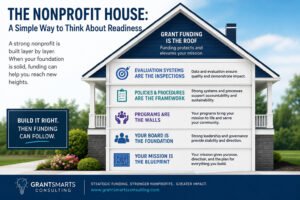
Imagine your nonprofit as a house.
Before anyone moves in, you need more than a beautiful exterior. You need a strong foundation, a solid framework, functioning systems, and regular inspections. If you skip those steps and immediately put a roof on the house, you may have something that looks complete—but it will not be built to last. The same principle applies to nonprofits and gives a simple way to think about grant readiness.
Too often, nonprofits begin searching for grants before they have built the organizational infrastructure necessary to successfully manage funding. They focus on finding the next grant opportunity when they should first be asking:
“Is our nonprofit ready for someone to invest in us?”
This is where grant readiness for nonprofits becomes critical.
At GrantSmarts Consulting, we believe funding should be part of a larger strategy for nonprofit development—not a substitute for building the organization itself.
The Nonprofit House: A Simple Way to Think About Grant Readiness
Think of your nonprofit as a house with six components.
1. Your Mission Is the Blueprint
Every strong house starts with a blueprint. Your nonprofit starts with its mission.
Your mission should clearly communicate:
- Who you serve
- What problem you address
- What you do
- Why your organization exists
A strong mission gives your organization direction and helps ensure that programs, fundraising activities, partnerships, and grant applications are aligned.
Funders want to understand why your organization exists and why your work matters.
If your mission is unclear, your funding strategy will likely be unclear too.
Your blueprint should guide everything you build.
2. Your Board Is the Foundation
A house cannot stand without a foundation. Neither can a nonprofit.
Your board of directors provides governance, oversight, accountability, and strategic leadership. A strong nonprofit board should do more than meet periodically and approve documents.
Board members should understand the organization’s mission, financial responsibilities, strategic priorities, and role in supporting organizational growth.
For grant readiness, funders may want to see evidence that your organization has appropriate leadership and governance structures in place.
Ask yourself:
- Are board members actively engaged?
- Does the board understand its fiduciary responsibilities?
- Are board meetings documented?
- Do board members bring diverse skills and community connections?
- Is there a clear distinction between governance and day-to-day management?
If the foundation is weak, adding more funding does not solve the underlying problem.
Strengthen the foundation first. A simple way to think about grant readiness
3. Your Programs Are the Walls
Your programs are where your mission comes to life.
They represent the services, activities, and initiatives your nonprofit provides to the community.
Strong programs should answer several important questions:
Who are you serving?
What are you providing?
Why does the program matter?
What outcomes do you expect?
How will you know whether it is working?
This is especially important when pursuing grant funding.
A funder is not simply looking for an organization with a good idea. They want to understand the need, the proposed solution, the population being served, and the expected impact.
Your programs are the walls of your nonprofit house. They need to be clearly designed, intentionally built, and connected to the blueprint.
4. Your Policies and Procedures Are the Framework
A house needs framing, electrical systems, plumbing, and other infrastructure that may not be immediately visible—but is essential to making the house function.
Nonprofits need internal systems too.
Policies and procedures help create consistency, accountability, and organizational stability.
Depending on your organization, these may include policies related to:
- Financial management
- Conflict of interest
- Board governance
- Personnel
- Procurement
- Document retention
- Whistleblower protections
- Grant management
- Data privacy
- Program operations
These systems may not be the most exciting part of nonprofit development, but they matter.
A nonprofit that receives $100,000 in grant funding without the systems to manage that funding responsibly can create significant organizational risk.
Infrastructure matters before and after the grant award. This is a simple way to think about grant readiness.
5. Your Evaluation Systems Are the Inspections
Before buying a house, you might have an inspection to determine whether the structure is actually functioning as it should.
Nonprofits need their own form of inspection: evaluation and measurement.
Grant funders want to know whether their investment is making a difference.
That means your nonprofit should have a way to track meaningful information about your programs.
Depending on your work, you might measure:
- Number of people served
- Program participation
- Completion rates
- Client satisfaction
- Skills gained
- Changes in behavior
- Employment outcomes
- Housing stability
- Academic progress
- Community impact
The right metrics depend on your mission and programs.
The goal isn’t to collect data simply because a funder asks for it.
The goal is to understand whether your organization is actually accomplishing what it says it will accomplish.
If you cannot measure your impact, it becomes much harder to communicate your value.
6. Grant Funding Is the Roof
Now we get to the part many nonprofits want to start with: funding.
Grant funding is important. It can help nonprofits launch programs, expand services, hire staff, purchase equipment, build capacity, and serve more people.
But funding should be the roof, not the foundation.
A roof protects and completes a structure—but it cannot hold the structure together by itself.
The same is true for grant funding.
A grant cannot fix an inactive board, create a clear mission, replace financial systems, automatically create measurable outcomes or make an unsustainable program sustainable.
Funding CAN strengthen a strong organization, but it should not be expected to build the organization from the ground up.
What Happens When Nonprofits Build the Roof First?
When organizations pursue funding before developing their infrastructure, several problems can occur.
They Apply for Grants They Aren’t Ready to Manage
A nonprofit may win funding but lack the staffing, financial systems, or administrative capacity to successfully implement the grant.
They Chase Every Funding Opportunity
Without a clear funding strategy, organizations may apply for grants simply because they are available rather than because they align with the nonprofit’s mission and programs.
Their Grant Applications Lack Evidence
If an organization hasn’t established strong programs or data collection systems, it can be difficult to demonstrate measurable impact.
They Become Dependent on Grants
A nonprofit that relies heavily on grants without developing individual donations, corporate partnerships, earned revenue, or other funding sources may struggle when a grant ends.
They Experience Growth Before They’re Ready
Growth sounds like a good problem to have but rapid growth without infrastructure can overwhelm an organization.
More funding often means more reporting, more expenses, more staff, more compliance requirements, and more accountability.
The goal isn’t simply to win a grant. The goal is to be prepared to manage what happens after you win.
Grant Readiness Is More Than Having a Grant Writer
One of the biggest misconceptions about nonprofit funding is that grant readiness begins with hiring a grant writer. But it doesn’t have to begin there. However, a skilled grant writer can tell your organization’s story, identify funding opportunities, develop compelling proposals, and help communicate your impact.
But a grant writer cannot create organizational capacity that doesn’t exist.
Grant readiness involves the entire organization.
Your leadership, board, financial systems, programs, data, policies, and strategic plan all contribute to how funders perceive your organization.
A simple way to think about grant readiness. Good grant writing tells your story. Grant readiness gives you a strong story to tell.
How to Know If Your Nonprofit Is Grant-Ready
Before submitting your next grant application, take a step back and evaluate your organization.
Ask:
Mission
Is our mission clear and reflected in everything we do?
Governance
Is our board engaged, active, and equipped to provide appropriate oversight?
Programs
Are our programs clearly defined and addressing a demonstrated community need?
Finances
Do we have accurate financial records, budgets, and financial controls?
Policies
Do we have the policies and procedures needed to operate responsibly?
Data
Are we tracking meaningful outcomes and program results?
Strategy
Do we have a plan for organizational growth and sustainability?
Funding
Are we pursuing funding that actually aligns with our mission and programs?
If you answered “no” to several of these questions, that does not mean you should give up on funding.
It means you may need to focus on capacity building before aggressively pursuing grants.
Build It Right, Then Funding Can Follow
There is nothing wrong with wanting your nonprofit to receive grant funding.
The problem is pursuing funding without preparing the organization to use it effectively.
Think about your nonprofit house:
Your mission is the blueprint.
Your board is the foundation.
Your programs are the walls.
Your policies and procedures are the framework.
Your evaluation systems are the inspections.
Your funding is the roof.
Build each part intentionally. Because when the foundation is strong, the structure is sound, and the systems are working together, your organization is in a much stronger position to pursue funding—and to manage it successfully when it arrives.
At GrantSmarts Consulting, we help nonprofits move beyond simply searching for grants. We help organizations build the strategy, systems, and readiness needed to pursue strategic funding with confidence.
Don’t put the roof on first. Build the house. Then pursue the funding that can help you grow it.
Ready to Assess Your Nonprofit’s Grant Readiness?
If your organization is preparing to pursue grants but isn’t sure whether your foundation is strong enough, a grant readiness assessment can help identify gaps and opportunities for improvement.
Grant funding is important.
But your organization’s foundation comes first. Build it right. Then let funding become part of the growth strategy.
Frequently Asked Questions About Grant Readiness for Nonprofits
What is grant readiness for nonprofits?
Grant readiness for nonprofits is the process of preparing an organization to successfully pursue, receive, manage, and report on grant funding. It includes organizational leadership, governance, financial systems, programs, policies, evaluation, and sustainability planning.
What do nonprofits need before applying for grants?
Nonprofits should generally have a clear mission, appropriate governance, defined programs, financial systems, organizational policies, measurable outcomes, and the capacity to manage grant requirements before pursuing significant grant funding.
Can a new nonprofit apply for grants?
Yes. New nonprofits can pursue grants, but eligibility varies by funder. New organizations should focus on establishing strong organizational infrastructure, developing programs, documenting impact, and building relationships with potential funders.
Why is nonprofit capacity building important?
Nonprofit capacity building strengthens the systems, leadership, infrastructure, and processes that allow an organization to operate effectively and achieve its mission. Strong capacity can also position nonprofits to compete more effectively for funding and manage grants successfully.
Does a nonprofit need a grant writer to become grant-ready?
Not necessarily. Grant writing is only one part of funding strategy. Grant readiness requires the organization itself to have the leadership, programs, financial systems, data, policies, and infrastructure needed to support successful grant implementation. If your organization needs help with grant readiness Book A Consultation
Contact Us for Your Grant Support
Company Name: GrantSmarts Consulting
Address: 7055 Engle Rd, Building 6-601, Middleburg Heights, OH 44130
Phone: +1 2167585429
Visit Our Website: Click Here
Google Business Profile